1800 270 846

53622 Burnett Highway, Bouldercombe, QLD 4702

Sustainable Construction

The construction industry as a whole has a responsibility to contribute to the creation of a world that will improve the lives of future generations and make use of environmentally friendly construction methods.

At Castle Evolution, we understand the significance of sustainable construction, especially in the current landscape where urbanisation is at a historic peak, driving up construction demand. Our modern construction method using cold formed steel (CFS) not only enables accelerated construction that requires less labor but also produces less material waste at the same time. It’s safe to say we’re passionate about creating a future for construction that’s more efficient and has less impact on the environment.

What is the significance of sustainable construction?

From energy consumption to carbon emissions, the construction industry has a significant environmental impact.

Today, the construction industry accounts for 36% of global energy consumption and 40% of global greenhouse gas (GHG) emissions. As the world becomes more focused on sustainability and green standards, construction has a big role in doing its part for the environment.

With ever-increasing sustainability expectations set by planners, building codes, and regulations, the minimum for everyone in the construction industry is rising. With an increased focus on the environmental impact of every industry, an increasing number of construction projects will require demonstrably sustainable approaches to meet client expectations.

There is a lot of focus on ‘reducing the carbon footprint of construction,’ but it’s important to focus on all three pillars of sustainability, economic, environmental and social. Sustainable development requires us to focus on economic growth, and social progress and promote environmental sustainability.

The move to sustainable methods of construction

For years, timber has been thought of as being the go-to method for construction as it’s seen by many as a natural and renewable material. But it’s not the best material to use when it comes to waste.

Nick Collins from the Nation Association of Steel-framed Housing (NASH), explained that only approximately half the timber in the plantation ends up being processed, and then only half of that again ends up as structural timber. “There’s an enormous amount of waste in the process that can’t be reused and so it ends up in landfill,” Nick explained. When considering that there is a high rate of decay in frames over the life of a timber building as well, there’s very little that’s positive about the timber sustainability story.

Steel, and CFS in particular, has quite a different story. Years of research has gone into developing sustainable construction methods, and in the past few years, carbon-free steel has become more commonly utilized by the construction industry. By using hydrogen as a fuel source, this can now give us an almost completely sustainable building material. Nick explains that the optimized use of carbon-free steel in the manufacturing process results in minimal waste which can then be reused and recycled. In some markets with renewable energy, the whole end-to-end process produces very low or even zero carbon emissions.

Corporate Social Responsibility (CSR)

Another interesting part to consider throughout the sustainability journey are the end users themselves. What we’re seeing in the industry is that more and more end users are concerned with CSR which is a concept that businesses should have a positive impact on society.

While it’s a concept more commonly used for buyer behavior, it’s influencing the construction industry too. People are now choosing to purchase & live in homes or commercial buildings that are built with minimal waste and are more energy efficient. This then influences how we in the construction industry need to construct our world.

5 REASONS TO USE CFS IN YOUR PROJECTS

Cold Formed Steel (CFS) or Light Gauge Steel (LGS) constructions is a practical, code approved solution to many of the limitations that builders face today when using traditional construction materials.

At Castle Evolution our construction methods using the FRAMECAD System ensure that your project is built faster, with lower costs, more versatile, with options of scalable design solutions and overall better building performance.

With these advantages combined with the inherent characteristics of steel including non-combustibility, termite and mold resistance and dimensional stability, LGS/CFS construction provides the framework for a solid, sustainable building project outcome.

There are five main reasons why building with Cold Form Steel is superior to traditional building methods, which we have outlined below.

1. Its Faster!

LGS/CFS construction is faster than traditional methods, especially during manufacture and construction phases of a project. Here at Castle Evolution we are able to supply frames pre-assembled, strong and straight, and clearly identifiable. In most cases no on-site, welding or cutting is required. This means that the erection process is fast and simple.

Advanced tooling functions provided by the FRAMECAD System allow high productivity and versatile output to produce roof trusses, wall frames, and floor joists – all supplied to exact measurements which will save time in the construction stage. These shorter construction times result in reduced costs of your overall project.

By building with Cold Form Steel over traditional heavy materials like concrete and masonry, you can save time on your project schedule.

2. Highly skilled labour on-site is not required
Working with the extremely accurate design software of the FRAMECAD System, pre-engineered steel framing is cut to specified lengths, labelled and pre-dimpled, making assemble simple, fast and accurate. This means the only tool needed for assembly is a power drill and provided screws and fasteners.

Due to this easy assembly, less skilled labour is needed on-site which again will reduce costs to your overall project.

3. It is versatile
The strength and ductility of CFS makes it an ideal building material for all building types including modular and pre-fabricated units, multi-story hotels, hospitals, schools as well as stand alone multi-story housing. It is suited to almost any type of building design or application and with one of the highest strength-to-weight ratio it is possible to produce architectural designs not possible with traditional methods.

4. It offers greater return on investment
Using LGS/CFS in your project is cost-competitive compared to traditional methods and depending on the building design, can be cheaper when evaluating the overall build cost due it the advantages of speed of construction, accuracy and reduced labour costs.

CFS is also highly scalable making it an ideal solution for mass production and repeatable designs. This is a huge advantage in areas in need of affordable, quality housing, specifically in developing countries.

Long-term building maintenance costs are also reduced as steel is resistant to rot, mold, termite and insect infestation.

5. It is better for the environment
With traditional methods, it is common for builders to factor in up to 20% material wastage in the total cost of a project. Adding this up over consecutive projects, wastage can be equivalent to as much as one building out of every five buildings constructed.

However building with CFS/LGS waste is virtually non-existent, using our FRAMECAD System material wastage is less than 1% due to the precise and true measuring of the design system.

Steel is 100% recyclable, reducing the overall environmental impact of any waste created and in most cases is a dry system, which means there is no need to use (often limited) water resources for mixing cement or other materials.

Castle Evolution

ON-SITE STEEL FRAME PRODUCTION FACTORY

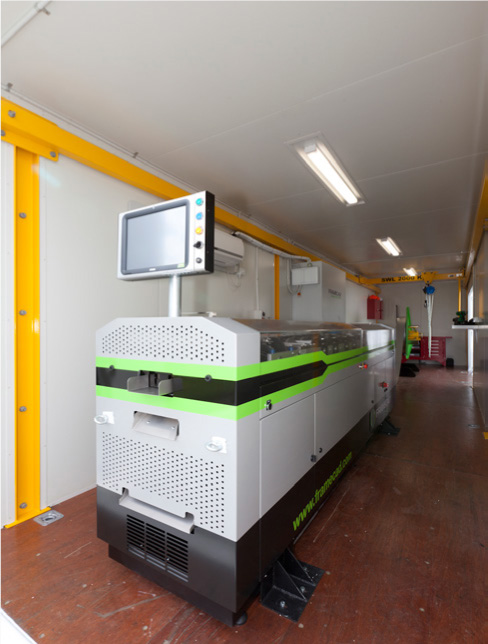
Castle Evolution is taking the building industry one step further, now having the capabilities to take our manufacturing factory direct to your worksite for large scale and remote projects. This takes the control of the production and fabrication straight to the front line of your project.

In the past, variations could hold projects up for days and sometimes weeks after engineering changes waiting for materials to be supplied. With our mobile factory, in most cases engineering changes can be made within hours and manufactured the same day, meaning there is no wait time on delivery of wall frames and roof trusses.

Using our cold-formed steel framing will cut down labour time and costs by two thirds which is a huge benefit in the market at the moment due to the current labour and skills shortage. The components are prepped for mechanical, electrical and plumbing, saving time and money on the project.

The Castle Evolution Mobile Factory has been designed to enable quick start production on any site. Its onsite, compact nature means reduced transport costs and overall lead times, as well as lower carbon emissions for larger projects.

Using CAD software, we have been able to design the ‘Type 3 Townhouse’ (pictured below), which shows how the framework will look (subject to final plans and engineering). This CAD software is accurate to within 0.2mm, which means you can be rest assured your framework will fit like a glove.

Once the final sign-off and engineering has been completed, the files are transmitted to the cold-formed structural steel assembly factory located on the project site where rolls of coiled BlueScope TRUECORE® steel are transformed into each individual component needed for your build.

Our Mobile Factory delivers on-site 100% engineered and customised steel framing in a mobile factory that transforms architectural inspiration into reality faster and more cost effective then ever before.